| Resources |
| History ...links to 1916, Lockout, Civil War |
| Language ... |
| Gay ... |
| An Ireland ... |
| At Swim home ... Reviews ... Extracts ... Gallery ... Abroad ... Resources ... |
| Jamie O’Neill home |
| At Swim, Two Boys Kilbrack Disturbance Short Stories Journalism Press! |
| Contact |


A memoir by William O’Brien,
Connolly’s friend and colleague
At the John Mitchel Centenary Concert in November, 1915, P. H. Pearse stated in the course of an address that Irish Insurrections of the past, instead of being "too soon," had all been "too late." James Connolly, who was present on the occasion, interjected at once: "Will the next one be too late?"
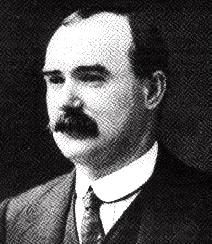
The outbreak of the European War had a marked effect upon Connolly. He then determined that an attempt should be made to establish Ireland as an independent Republic, and with that purpose he sought the co-operation of other persons and forces having the same object in view. The outcome of these interchanges of opinion was a meeting in the Gaelic League premises at 25, Parnell Square, which both Connolly and myself attended. At this meeting we met the leaders of the Irish Republican Brotherhood, the Irish Volunteers, and others, and plans were discussed, including one for the seizure of the Mansion House to prevent a meeting being held to be addressed by the late Lord Asquith, then British Prime Minister, who was about to visit Dublin. Connolly was inclined to be doubtful whether many of those who were present at the meeting meant business as he did. When the late John Redmond, leader of the Irish Parliamentary Party, made an important speech at Woodenbridge, I wrote to Connolly, saying that I thought Redmond's speech was the parting of the ways for many in the volunteer movement. He replied: "Yes, I saw the speech of Redmond. It is a desperate situation; and I am afraid that our friends of the conference have not got sufficient dash and desperation to deal with the matter. The meeting for Asquith will be a military affair, and the city will be in the hands of the military to carry it through. In a sense, all our future is on the cast of that die. I am ready for any call."
His part in the Insurrection of Easter Week is well known.
He had no illusions about the prospects. As we parted in Liberty Hall shortly before noon on that Easter Monday of 1916, he whispered to me, "We are going out to be slaughtered." When I asked "Is there no hope?" he replied "None whatever." Yet I never saw him look happier or more satisfied.
During the fight he was wounded, but insisted upon continuing in command, having a bed made among the fighters in the General Post Office. While thus lying down he was brought a cup of tea, and his comment upon this attention was "This is revolution de luxe!"
He was in great pain when the surrender came and suffered a great deal being then too weak to write his endorsement on the Order for Surrender signed by Pearse; yet when he was given the document to sign he made a material correction in its terms by inserting the word "only," which can be seen in his handwriting on the published facsimile of that famous document. He had no illusions as to his fate, and he faced the end fearlessly, saying, when asked if he would pray for the firing-party waiting ready to execute him, "I will pray for all brave men who do their duty according to their lights."
That was the Connolly I knew; brave, kindly, human, even humourous. In the most critical situation he could always discover a human and humorous side, and when during the war period I drew his attention to the fact that the Dublin Correspondent of the London "Times" stated that practically every building in Dublin displayed recruiting posters with the exception of Liberty Hall and Trinity College, his comment was "Two well-known seats of learning." It is well-known that Connolly was responsible for the method of street warfare adopted in Dublin during Easter Week. He had lectured on this subject frequently in many parts of the country.
Once when explaining this method of fighting to a meeting of volunteer officers he pointed out how unpopular it would make them with the people whose homes and belongings would be endangered or destroyed; but he added,
"Never forget that if we succeed all our sins will be forgiven, if we fail all our virtues will not save us from the gallows."
Talking on the same subject to the Citizen Army he explained carefully the kind of trenches that should be made, and how the defenders must protect themselves. At the end of the talk one young member asked Connolly what he must do if a high explosive landed in his trench; to which Connolly replied, "Don't worry, it will never trouble you."
A very youthful member of the Citizen Army, aged 16 years, told Connolly early in 1916, he was going into hospital for an operation, and asked that the insurrection be postponed until he would be again available for duty. Connolly laughed, and asked how long the boy would be in hospital. When he was told he said that would be all right as he would arrange to postpone the insurrection until the prospective combatant had been discharged from hospital.
In one of the last speeches he made in 1916, he commented upon the apparent slowness of the growth of liberty, illustrating his point by saying that it was not so very long since he would have been hanged for what he was then saying. "But," he added, "I won't be hanged for what I say to-night, though I may be hanged for what I'll do to-morrow."
Connolly lived as he died – fighting. He was fighting when I first saw him in 1897, when he was organising a protest against the celebration of Queen Victoria's Diamond Jubilee. I was then a boy of 16, and Connolly was 29; to my boyish eyes he then looked a man of from 40 to 45 years old, and I was greatly surprised when I later discovered his real age. He was a low-sized, sturdily-built man, speaking with a pronounced Scottish accent. He had arrived in Dublin only the previous year, 1896, and had established the Irish Socialist Republican Party, of which he was the leading speaker. His parents were natives of County Monaghan from which they were forced to emigrate, and they settled in Edinburgh, where James Connolly was born on June 5th, 1868. Connolly's father was employed in the service of the Municipality.
Following this first meeting I attended most of his meetings, and was much impressed by his powers as a speaker. He was extremely well informed in Irish historical and economic subjects; his speeches were clear, logical, forcible, and well delivered. He never used notes, and he never wandered from his subject; was ready in answering questions, and could be wittily crushing in repartee. '
I remember one occasion when a listener who tried to be funny asked Connolly, "What will win the Derby?"; and instantly the reply came, "A horse, and I am surprised at an ass enquiring!"

In August, 1898, Connolly founded and edited a paper "The Workers' Republic," the first issue of which appeared on the occasion of the laying of the foundation-stone for the Wolfe Tone Monument at the Stephen's Green end of Grafton Street. Connolly's leading article was on Wolfe Tone, and it opened with this sentence: "Apostles of freedom are ever idolised when dead, but crucified when living." That sentence might well be applied to himself now. One humorous episode connected with this paper occurs to me. An action for libel was taken against it; the paper was very small, and when it was handed to the Judge in the Court he looked at it for a second and then said "Where is the rest of it."
In the early days of the Boer War, Connolly played an active part in dissociating Ireland from the British attack upon the South African Republics, and when Joseph Chamberlain visited Dublin he joined with other Nationalists in organising a public meeting to express Irish sympathy with the Boer Republics. This meeting was banned by the authorities, but Connolly and some others decided to hold it despite the ban. The police prevented the meeting assembling at the advertised place, so it was decided to drive around the city in a two-horse brake, holding short meetings at different places, and a big meeting outside the city boundary, where the ban did not extend. But the driver of the brake refused to continue the journey, so Connolly took the reins; the wagonette was stopped by the police and Connolly was arrested. Later he was charged with attempting to hold a meeting which had been legally proclaimed, but on the following morning in the Police Court this charge was withdrawn and he was charged instead with driving a licensed vehicle, he not being a licensed driver. On this charge he was convicted.
In 1903 Connolly was forced to emigrate to the United States, where he spent seven years.
While there he worked at many jobs, and he was also organiser for the Industrial Workers of the World, then but recently established. He learned much in America, but he was never happy there and was always thinking of the possibilities of returning to Ireland. I wrote him about this, and he explained his position in a letter to me in May, 1909. "I may confess to you," he wrote, "that I regard my emigration to America as the great mistake of my life, and I have never ceased to regret it. Your letter has aroused the call of Erin in my blood until I am always dreaming of Ireland, dreaming of going back to the fight at home. Of late I have been studying very attentively the situation in Ireland, so far as it is possible to do so at a distance, and I am very much impressed with the belief that all the conditions are favourable for a forward move in our direction. That thought has filled me with a burning desire to get back, but as an individual the position was hopeless. ... I see my way to raise my passage money, but I do not see my way to live after I once set foot on Irish soil. I could not go into the Dublin slums again to live; one experience of that is enough for a lifetime. My children are now growing up, and it is part of my creed that when I have climbed any part of the ladder towards social comfort I must never descend it again. ... I am vain enough to believe that I could do good work in Ireland. I am dying to go, but how? If you can answer that question future generations (of little Connolly's) will rise up and call you blessed."
The difficulties were very great, but by the following year I got together a Committee, of which I was Secretary, to arrange for his return. As the time for his departure from the U.S.A. approached I felt it my duty to tell him of some adverse factors. His reply was, "Your letter received. Cheer up, my boy, we never died of winter yet. Be assured, whatever happens, no blame is put upon you for not being master of circumstances. I'm not kicking."
On his return to Ireland in July, 1910, it was at once apparent that he had greatly developed as speaker, writer, and man of affairs. His appearance, too, had improved, and when my mother commented upon this improvement he replied: "While I was away I got something to eat." The publication of his book "Labour in Irish History" shortly after his return did much to establish and spread his reputation. I remember that he was much impressed by the plays of the Abbey Theatre, which had been established during his absence. He was particularly pleased with William Boyle's "The Eloquent Dempsey," saying that there was hope for Ireland when the people could laugh at such a play.
In the following year, 1911 he changed his residence from Dublin to Belfast and there put up a great fight for the dockers and factory girls for whose organisation he was responsible.
He came to Dublin occasionally, and was here almost continuously during the big lock-out in 1913. His handling of difficult situations then evoked general admiration, and it was with his concurrence while he was in charge in Liberty Hall that the Irish Citizen Army was formed by Captain J. R. White. In the course of that historic struggle a special Trade Union Congress was held in London, at which some speakers suggested that as "they paid the piper they were entitled to call the tune." To this Connolly replied vigorously, telling them that this was a good doctrine as between buyer and seller, and adding forcibly "But we have nothing to sell, least of all our honour."
Early in 1914 a meeting to protest against the partition of Ireland was held in O'Connell Street, and all the speakers were fined for assembling where no right of public meeting existed. Those fined refused to pay, and I was imprisoned. Connolly arranged a meeting to protest against this, but I was released before the sentence expired. Connolly told me "You have spoiled our meeting by getting released; now people will think the meeting is a protest against your release." There was some criticism about this second meeting being called at Beresford Place instead of O'Connell Street, and Connolly's comment upon it was "that when he made arrangements to go into O'Connell Street he would not be beaten out of it by policemen's batons." When the time came he went into O'Connell Street to some purpose. In the course of a speech he once asked how they were to accomplish their work. A member of his audience promptly shouted "With the rifle." To this Connolly replied "Our task will only commence when the rifle has done its work."
He was fond of emphasising that while Irishmen were physically brave they had little moral courage, and often spoke of men who would give their lives for Ireland's freedom, but were afraid to risk their jobs. He willingly risked and lost both.
top