| Resources |
| History ...links to 1916, Lockout, Civil War |
| Language ... |
| Gay ... |
| An Ireland ... |
| At Swim home ... Reviews ... Extracts ... Gallery ... Abroad ... Resources ... |
| Jamie O’Neill home |
| At Swim, Two Boys Kilbrack Disturbance Short Stories Journalism Press! |
| Contact |


from the Kildare Observer, November 27, 1915
THRILLING FIRST-HAND STORY BY A NAAS MAN
THE LANDING AT SUVLA BAY
THE TRIALS OF THE TROOPS
We have received the following interesting account of the "Dublins" part in the landing at Suvla Bay from a soldier who was, not long ago, a popular figure in Naas –
"On the evening of 6th August we set sail from an island in the Aegean Sea, after a dreary wait, and heartily sick of the rather uneventful voyage from dear old England (even England was a home after we left the Emerald Isle). The island we were leaving was like a page from "Arabian Nights" - a fairyland. The harbour, which we entered through a narrow, winding passage, was surrounded by mountains, mostly under cultivation. By ingeniously arranged parapets the soil was kept from tumbling into the sea below, for the mountains approached and formed an impenetrable barrier to the huge seas which frequently disturbed the calm waters of the harbour. The harbour was almost land-locked, and completely shut out from the view of the sea and the entrance was so well concealed that it was only on close approach and careful scrutiny that one could discover it. Occasionally we went route-marching on the island itself, and there among the noise of the myriads of insects, birds, olive trees, etc., we loosened our legs and hoped to keep up to our high standard of training. "The patrol boat sped merrily along in a north-easterly course carrying two companies of as light and gay-hearted boys as ever left the shores of old Ireland, the face of every man expressing the pent-up feeling of a long earnest preparation for the fray of which they were on the eve". No one looking at these brave lads would dream that on the morrow
THEIR MANGLED CORPSES
would sprinkle that acrid wilderness of death (the Gallipoli) in sacrifice for their country and in defence of Christianity. After tea was supplied we lay down to sleep, for our hands and consciences were free, and the fight we were going to throw our very souls into stirred up our natural instincts, and above all we were determined to prove to the hilt that there is naught to equal the dash and daring which tradition has handed down to us as something sacred and the quality of the Irish soldier. The tales of bravery and sacrifice of that brave Irish Division were scarcely even heard of at home save to those who read between the lines in the casualty lists. And even there one finds gaps and gaps not yet filled in. Perhaps one day the world will read of the deeds of the immortal –Division. "Someone had blundered". Leaderless, deprived of its famous General, this Division made history in spite of this set back.
THE LANDING
"We reembarked from the patrol boat to a small flat-bottomed boat packed like sardines, but before we left we were treated to a few shells from the Turkish batteries, which looked down and commanded the plain beach and sea from the frowning precipitous mountains that form the back bone of the Gallipoli and our goal. One shell fell fifteen yards aft and sent up a waterspout forty feet high. These fastness we were to attempt to storm in the course of time. They did not damp our Irish spirits. We had only put off when another "luckier" or more accurate shell went through the patrol boat's funnel as she turned and steamed out of range, leaving us on our way to the beach. When about 100 yards from this point little innocent puffs of smoke burst and hung above our heads, to the right and left of us and told us we were within range of the enemy's smaller guns which were in well concealed positions, while the deafening roar from our cruisers, destroyers, etc., which flitted in and out the bay, reminded the foe that we intended to make our presence felt. Our boat grounded. With a cheer and shout to "Jack" to "send it into 'em'," the boys leaped, lighting ashore on the shingle, loaded with ammunition, three days' rations and packs, and dashed up to cover under the headland which afforded perfect shelter. This head land formed the right hand promontory of Suvla Bay, looking landward from the sea. Our platoon was detailed to remove the reserve stores, ammunitions, etc., from the boat and this was accomplished without a single casualty, though the sea all around the boat was whipped white with foam from the descending shrapnel bullets. After a short rest of about half an hour we crossed the headland and advanced along the beach of Suvla Bay. Half way, we divested ourselves of our packs and
WHAT A RELIEF TOO!
The sun was getting up and the heat was intense. All the while the enemy kept up a steady and incessant shrapnel fire, but our ships soon located their batteries and silenced them one by one. The wily Turk had something else in store for us, for as we approached the "Causeway" (a muddy passage through which the overflow of water that covers the salt lake in the rainy season and flows into the sea, but was now soft sand that covers its bed) they hurled a perfect hail of high explosive shells from their big guns which ploughed deep into that muddy swamp. We had to cross this "causeway" - Providence was on our side, for many shells failed to explode. However we lost many in that mad race across that 30 or 40 yards of mud and swamp. "Another halt here under good cover for our heads lay a plateau littered with many brave "York" and many more Turkish dead. We help to collect the dead, but could not reach on it before nightfall. In the meantime we helped to bring up supplies, etc., from where our boat beached, to this "rest" for our brigade, and weary work it was too. Our 7th battalion (for I have omitted to say ours is a battalion of the Dublins) got orders to advance and take a hill and ridge that overlooked and commanded the Salt lake, and which hill was afterwards was known as DUBLIN HILL. Down came the wounded in a continuous stream to a dressing station, beside where we lay, to be patched up and laid side by side on the beach, until they were removed on a small boat to the hospital ship out on the bay
WATER! WATER!
was the cry of the wounded, and all alike. We could get some of a sort - but the wounded. Also, the poor chaps had another scourge to contend with besides their thirst and maimed bodies, for they were unable to keep away the flies that infested that awful inferno. This was on Saturday, 7th August. We had settled down for the night, but past midnight we "fell to" and received orders to take up ammunition to our brave 7th, whom we learned then had crowned themselves with glory by taking "Dublin Hill" at the point of the bayonet after a magnificent charge. Loaded with ammunition and the darkness enveloping us we stole out noiselessly into the silent night, as silent as the dead that lay all around us - not a sound could be heard on that carpet of sand that lay ankle deep. Occasionally the stillness was broken by a sudden and intense burst of rifle fire that told the tale of our boys advancing, for the fire we knew came from Turkish rifles -we learned to recognise the sound of them quickly enough. Our boys did most of the work
WITH THE BAYONETS,
and that weapon when we had the ghost of a chance never failed. When we reached the edge of the lake the ridge and the hills were lit up as light as day - our navy were active. Their searchlights swept the heights and their guns spoke out death again. We had to lie low, for one of the beams was thrown on us as we climbed the ridge, and we could see that our 7th Battn. had paid dearly for "Dublin Hill". Back to the Causeway shelter once more, and a few hours rest. Sunday - and to work again; an endless stream of fatigue parties reached from the landing place across the Salt Lake and up to the ridge. This continued throughout the day. Our limbs were weary and sore, but we did not mind, for our comrades needed food and ammunition. Neither Father Murphy nor Canon McLean had reached the peninsula, so we had
NO CHURCH SERVICE.
On Sunday evening several monitors and cruisers opened a tremendous bombardment on a point or defile on the mountains above us (Gibraltar on a gigantic scale). "I got a pair of glasses and crept out to a point of vantage on the plateau above our rest camp, and there I watched a terrible spectacle. Through the defile poured dense masses of Turkish Troops, which had been hurried across a Narrows and through the pass to reinforce their troops below. Broadside after broadside sped over my head with a whistling noise - the twelve and dreaded fifteen-inch guns sending their death - dealing missives into the masses of the enemy, making gaping lanes and avenues through that living wall, and the accuracy of the gunners was marvellous. Thank Heaven, a lot of this horror was hidden from my view, for the havoc wrought must have been awful. Glaring spurts of flame and dense cloud of black greenish smoke hung like a huge curtain over the pass and obscured my vision and put an end to any further hope of seeing this continuing stream of destruction. This
SLAUGHTER WAS KEPT UP
all the afternoon, and I withdrew with my whole being worked up to such a state of tension that I felt like killing something or someone. I was appeased - a rat or other similar animal I happened to disturb from its ravenous and gruesome feast among the dead, close to where I watched, raced towards me. I seized a stout walking stick and made a swipe at the beast as it hung in mid air, leaping from the plateau above me, and scattered its mangle remains on the rocks below. I felt pleased with myself at this, my first victim. After this I went out and obtained water and flung myself down to sleep, but very little came. My thoughts flew across the miles of lands and sea to the home and
DEAR ONES IN OLD IRELAND;
every face of friend and comrade I left behind me stood out in those fleeting moments. I thank God for those pleasant thoughts; they buoyed me up for the ordeals to come: to defend those loved ones, to fight and die for that dear home -what nobler sacrifice could one hope for? I was not fated then to die, but when I now look back and think, what a nobler end could I attain or aspire to? Conscience free, only a few cures to meditate on, one could feel certain of happiness after the cold grasp of death seized hold of ones worthless body. Again, what better ideal could one have in facing our foe - the persecutors of Christianity - the Huns! What better ally could the Huns take in their vile crime than the time immemorial haters and persecutors of Christendom - the Turk. Speaking of the Turks, I must say a word in praise of their fighting qualities. They are strong, wiry and good marksmen. Even their womenfolk can shoot pretty straight, but they don't feel anxious to face the cold steel. They hold on to a trench, pumping lead on us in the hope of driving us back before we reach their hurriedly dug narrow trench.
WE ARE ON THEM NOW.
They throw away their rifles and a mad stampede begins - the rest in that awful confusion is easy for us. Unfortunately it is not so easy now to get so close as in the early days of the Sulva Bay fighting. I have wandered a lot from the narrative I am trying to describe, but then one's thoughts and impressions under the circumstances must rise to the surface. In one of my wakeful periods of that Sunday night I thirsted for water and when I stretched out for my bottle, which I had left by my side, and found it was gone. I got one among the dead and stole of to the beach, steeping over the sleeping forms of my comrades, and reopened a hole we called a well and filled my water bottle with the fluid obtained from it, but which contained more mud and sand than water. I quenched my thirst and was settling down to sleep when we got the orders to "fall in" and we knew we were about to move up to do our share. The evening previous we drew our food supplies and put them in our ration bags, which we attached to our belts. It was about two hours before dawn, and across the Salt Lake once more we moved. Almost across, and one of our chaps was careless enough to forget putting his safety catch to the rear, and a round went off accidentally and
A CHAP IN THE FRONT OF HIM GOT HIT.
Immediately after this report the bullets came hissing and whistling over our heads and we obtained shelter under the ridge. Here we received our orders; we were to act as support to the _ Brigade and attack Chocolate Hill. Amidst a storm of shrapnel, high explosives and bullets we advanced at a double across the bushy and uneven plain, and were soon in the thick of it. The country we were covering was a wilderness, intersected by numerous gulleys here and there a corn field with crops in stacks, but the greater part was barren rock thick with scrub which our enemies made the most of. All around
MEN FELL LIKE CORN BEFORE A SCYTHE.
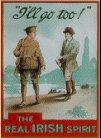
| “Enlist? Is it me enlist? And a war going on!” A young man’s reply to a girl enquiring had he enlisted, quoted in FSL Lyons’ seminal work, Ireland Since the Famine, Fontana, London, 1973. |
On we went; I got detached from my battalion among two battalions that were forced to retire. We rallied and recaptured a trench. An officer (wounded) of the Staffords took command; also an N.C.O. of the Royal Irish, who worked like heroes. The officer's trouble did not end with his first wound, and we forced him to go back and be seen to, and send us reinforcements. This he reluctantly did and another officer coming up, took charge. I took charge of a mixed lot and got orders to advance a half-left to check an advance of the enemy that were outflanking us and sending across a destructive enfilade fire. After a few adventures and narrow shaves we got in touch with the enemy and got them on the move over the hill and down to the railway. It was here I "stopped one". I shall ever remember that brave Stafford officer and Irish Fusiliers N.C.O. I was proud of being Irish then. When I got hit I thought it was all over. My bandage was used on the officer and I was alone, for the Turks had got reinforcements and forced the boys back. But over rushed
THE BRAVEST MAN I EVER MET,
I believe he was a Stafford, and rushed up to me with a shout, "Come along, I won't leave you". He fixed me up, but a machine gun got him and "winged" both his legs - the fix was complete. It was now my turn to patch him up while he pumped bullets into the on-coming Turks. He held them back, and we got back yard by yard, blazing away all the while for dear life. He never uttered a groan as I dragged him through the undergrowth. God and nature of the ground saved us. We got back safely, but not before the poor chap got another in the shoulder, which I did not discover till I put him on a stretcher and had him sent down. I never saw him after that nor, I suppose, never shall again, but God bless him! I got down to the bench without much incident. Now I ask,
WHAT ARE THE BOYS AT HOME DOING?
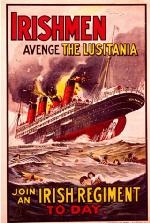 At one point I was going to have Doyler, in At Swim, upon seeing this poster, remark: “They’ll have us fighting icebergs next, in revenge of the Titanic.”
 |
Do they love their mothers, fathers, sisters, and do they love their home? Do they realise what is threatening all those? Yes, they love their homes, people, and the rest, but they don't realise that all are on the brink of destruction. They go their ways saying "Oh, our soldiers will win; the war will soon be over long before I enlist and become a trained soldier, and that would be so much lost time." And on they go all unconscious. Unfortunately other (pro-Germans) utter the parrot cry of, "This is England's war not Ireland's". It cannot seem possible - they know not what they say. I cannot believe that in Irish hearts they would willingly and knowingly turn their own and their fellow creatures' mind from defending that Christianity we glory in, and the deeds we still cherish of our fore fathers who bled and died for our faith. No, it is impossible. Let us pay no heed to their terrible blasphemies, and end this awful war. Do any of us want this terrible scourge of war? A thousand times "No", and to end it
I IMPLORE THOSE ABLE-BODIED MEN
in Ireland (and I know there are a good number) to help us terminate the war. Enlist at once, I say to all, and form a huge army - the news of this army in training would soon travel to Germany, and they would realise what they would have to meet should they have the remotest chance of wiping out our present great and glorious one. Their Hunnish heart would give way - it would be hopeless for them to continue. Would to Heaven I could, or some more able person than I - a mere "Tommy" - have a straight talk shoulder to shoulder and put before them the peril which they and their homes stand in. Unless they are craven cowards at heart they would spontaneously throw in their lots and crush the enemies of Christ.
"A Tough"
top