| Extracts |
| Jim goes to Confession ... |
| Mr Mack discovers the Rising ... |
| The Prologue and a note on the differing US versions ... |
| An unused passage ... |
| The First Chapter (courtesy Simon & Schuster, Canada). |
| NY Times audio The first two passages above read by the author, courtesy of the New York Times. |
| At Swim home ... Reviews ... Extracts ... Gallery ... Abroad ... Resources ... |
| Jamie O’Neill home |
| At Swim, Two Boys Kilbrack Disturbance Short Stories Journalism Press! |
| Contact |


ex Chapter 19
Mr Mack is Jim’s father. He’s a man of significant face and consequential airs – he was once a quartermaster sergeant in the British Army. Now he runs a corner-huckster’s store. His great wish is to be thought a gentleman, and for his son, Jim, to be seen doing gentlemanly things. Part of the novel is Mr Mack’s coming to understand – beyond respectability and being a dignity in the parish – it’s his son, and his own great fatherful love for him, that’s most precious to him in the world.
He’s a bumbling sort of fellow, and in this passage, he more or less bumps into the Easter Rising.
Mr Mack was a touch light in the head leaving that pub, and considerably lighter in his pocket, having stood treat, for some very practical reason that escaped him now, a round or was it two for the house. What time was it at all?
He came out at a crossroads, King Street said the sign. He stood at the corner. High and low he stared, puzzled to an amplush. He couldn’t make it out at all. It seemed to him there were evictions up and down the street. Bedsteads coming out of the little houses, mattresses, a settee even. You’d think all the bailiffs in Ireland had suddenly descended this day. And a rum set of bailiffs they looked too, no more than boys the most of them. Out of every house they came, lugging some old goods or other and piling them in the street. Children were bawling, women were tugging at their belongings, beseeching, all manner of language, dog’s abuse at the shrill of their voice. And the piles extending right across the street. Now what sense was there in that? Only blocking the public highway.
Mr Mack took a step towards them. The street crunched under his boot. Everywhere he looked, broken glass. Broken glass everywhere, bits of bottles and plate glass smashed. How long was this he was on the skite in that lushery? He didn’t know but a riot was after taking place in the meantime. And never a constable in sight.
A cart was jolting towards the crossroads and Mr Mack ran out. ‘Halt,’ he called. ‘Don’t come down. There’s glass in the road, she’ll slip and hurt, the beast.’
One of the bailiffs stepped out. He had a gun. He had a gun pulled on the carter. ‘This cart is commandeered,’ he said.
‘Take the gun, take it off him,’ a woman shrilled. ‘Shirkers, they’s only cowards.’
Mr Mack said, ‘What’s going on here?’
The woman turned to him. ‘They took me bed, they took me only bed they did.’
‘The republic will repay you, missus,’ said the fellow with the gun.
‘What republic?’ said Mr Mack.
‘Get down off that cart,’ said the gunman.
They took the cart. They turned it endways up with the bedsteads and mattresses. The woman was explaining to Mr Mack, as a man of some authority in a bowler hat, that it was the bed her mother had left her, her poor mother, God rest her soul, she died in that bed.
The carter’s cob whisked its tail. The carter looked round the circle of people. ‘Ye saw that. Ye won’t deny it. He had a gun on me.’
‘Daylight robbery,’ said a man at the door of his shop.
‘Ye’ll back me up. He had a gun.’
Suddenly, down the street, came the sound of gunfire. Holy Mother of God! Screaming and shoving, the people scattered, Mr Mack with them, dodging into doorways. Mr Mack peeked out: nothing in the road save three girls who stood in a row with their aprons hitched, gaping, and a curious weazen man who hopped about – he had lost a boot – hopped about, bleeding from the glass and dodging bullets the same time. Making an extraordinary stookawn of himself for there were no bullets to dodge. Nothing at all was happening, and, gingerly following the lead of the bolder class of urchin, Mr Mack came out in the street again. Another crackle of musketry and they were all scarpering anew, but the fire was sustained now, and clearly from down by the river – way down by the Four Courts, Mr Mack heard. He had received a fierce dig in the ribs and he was looking about for the culprit, saying ‘Now now’ with his finger raised, when a cry went up. Lancers! The Lancers! The Lancers is coming! Some dashed ahead only to hurry back, rejoining the mass that generally surged forward, sweeping Mr Mack along. ‘Now we’ll see the fun,’ said a man in his ear. ‘The Lancers is the boyos will sort them blackguards.’
But that musketry came from no Lancer’s carbine. Mr Mack recognized that barking discharge, inconceivable though it was in the streets of Dublin. Mausers without a doubt, great blunderbussy yokes of things the Boers had always favoured. But what would the Boers be doing in Dublin? A hurry of hooves ahead; a screaming avenue formed in the crowd; terror big in its eyes, a riderless horse bolted through.
Up sidestreets surged the crowd, searching, anywhere, to centre its alarm. Dumbly Mr Mack was carried along. His head he found was somewhat obfusticated in drink: he could form no very clear understanding of what was happening and the natural malignity of streets worked on him so that he had no notion at all where he was in this maze of back alleys and cuts. Horse-clops echoed everywhere, many many horse, or a few gone galloping wild. The Boer-war Mausers growled still, and it would scarce surprise him now if de Wet himself appeared at the head of a commando – wasn’t it always whispered de Wet was none but Parnell returned?
But who came in the end was only two bewildered troopers. They hunched over their mounts, evidently lost, and the mounts, their reins trailing, snorted and blew. Someone shouted the rebels were at the barricade. And yes, it did look like a barricade, now Mr Mack came to regard it. The Lancers fired quick cracks off their carbines. ‘There’s a child down!’ someone shouted. Mother of God, we’ll all be slaughtered. The barricade returned a broken blustering volley. Chunks of masonry showered off the walls. The crowd had scattered, losing Mr Mack his hat. The two horses bucked and tossed, going at a strange diagonal gait, sparks firing off the cobbles, till they reared wildly, bucketed up another sidestreet. ‘A child is down!’ the call kept going round. Mr Mack darted out to retrieve his hat. And the crowd, that stupid poking gawping mass, heaved behind him again, pushed him down once more to the barricade, breached the rickety thing and flooded through, tumbling it down behind them. Mr Mack glimpsed a face bloodied below, not a child’s thank God, trampled over.
A group of men from the barricade – some had green sort of uniforms on them – were advancing with rifles up the farther street. ‘Who are they supposed to be?’ said Mr Mack.
‘Them’re the Sinn Feiners,’ said his neighbour.
‘Oh, they’re Sinn Feiners,’ said Mr Mack, peering the better to see these queer near-fabled specimens.
‘They’ll be thinking to cut the troopers off at the corner.’
Mr Mack saw them kneel and ready their aim. He crossed himself. ‘If them fellows know to shoot at all them Lancers’ll be slaughtered,’ said his neighbour, ‘King’s men and all.’ Mother of God, we’ll all be slaughtered. Some in the crowd yelled a warning, but no horseman would hope to hear above those cobbles. The troopers came. The rebel guns fired. Snarling they fired. The troopers slumped from their saddles, thumped in the road.
The people stood stunned. Murderers! someone called, but the cry was not taken up. Stunned, disbelieving, appalled – and fearful. Slowly the people moved back, separating from the deed-doers. A Sinn Feiner lad ran down the road waving a trooper’s lance. In the quiet of the fading hooves he waved it. He had a flag attached. A queer flag, in equal divisions, green white and orange. He lodged the lance in a manhole plate in the middle of the street, and there the flag flew, green white and orange. ‘Murderers, murderers,’ came that voice again, all alone in the quiet. The lad’s face flushed with a ferocious courage. He raised his rifle and fired in the air. Only then did his comrades cheer, and they too fired off their guns, that furious joy of blooding.
Mr Mack turned and blundered through the crowd. He blundered by the dead child and the woman who Murderers! Murderers! wailed. Along the lively inquisitive streets he lurched. He must find his tram. He must be home.
Nelson’s Pillar fingered from out the housetops. He fixed its direction in his eye, and for once his eye did not deceive his feet. Indeed, a hard push and a scrape it would be, avoiding O’Connell Street that holiday afternoon. Every tenement, every fever-nest, every rookery in Dublin was spilling its contents in the road and it seemed to Mr Mack all slumdom must reel its way to his tramstop. Every shawlie and shabaroon, every larrikin and scut, every slut, daggle-tail, trollop and streel, frowsy old bowsies and loitering corner-boy sprawlers in caps, every farthing-face and ha’penny-boy, every gutty, gouger, louser, glugger, nudger, sharper, shloother, head, every whore’s melt of them, mister-me-friend and go-by-the-wall, the dogs in the street themself – all rascaldom was making for Mr Mack’s tramstop; and he must pinch and shove to gain any headway at all.
At last he stood on the Pillar steps. The great wide splendid thoroughfare – O’Connell Street was you a Catholic, Sackville Street was you at all in the Protestant way (was it any wonder if a man went astray in this town?) – swarmed with a wild ree-raw mindless throng. Every now and then the shout would go up: Troopers! or The military! or The polis is coming! or They’s shooting wild! and the crowd would stampede him by, leaving Mr Mack to cling to the pedestal, as to a cliff, to keep any footing. Tricksters was all, hoaxsters, for no polis came, no military. Loot was master. By him sailed the most fanciful apparitions. A slum-boy in three tophats swinging golf clubs. Dirty-faced girls with boas and high-heeled shoes on. The mess of life veered and shifted. Another plate window crashed.
Across the way where the crowd thinned was the General Post Office. The Sinn Feiners held it. He could see nothing of the Sinn Feiners themself bar the muzzles of guns that poked from the windows and crouching forms behind the parapet on the roof. That same strange unaccountable flag, green white and orange, flapped above them. What on earth would Sinn Feiners want with a post office? It crossed his mind in a daft way that they, like him before, had mistook it for a bank.
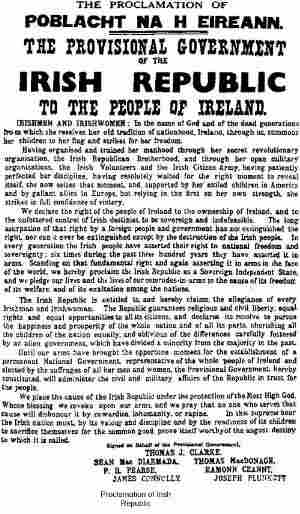
Handbills were posted all about. Slap-dash affairs with shoddy spacing and type. Something in Erse. Some further flim-flam in English. The Provisional Government of the Irish Republic. To the People of Ireland. Signed then by a poweration of names nor he nor anyone else had heard of.
The Lancers had charged here too, it was told. There was a dead horse down the way. All about the steps, flowers were strewn and trampled, where the flower-sellers’ stalls had been toppled. Barricades blocked the side streets, erected of particular things: bicycles jumbled and piled in one, hunks of marble for another, bales of newsprint – the work of disparate guilds whimsically chosen. Trams had been overturned. There were no trams running. No juice, the tramman told him. Even trains: the Sinn Feiners had dug up the lines. And no polis. No polis anywhere. Withdrawn to barracks. Every last pigeon-hearted lily-livered chicken-gutted sneak of them. It was pandemonium. It was Donnybrook Fair. It was all ballyhooly let loose.
Naming calls: and he did not dare put words to his fear. But he knew the green uniform Doyler would always be wearing; and he had seen the wish of that Sinn Feiner boy’s face. Jim’s age, no older. He must get home.
© Jamie O’Neill.